
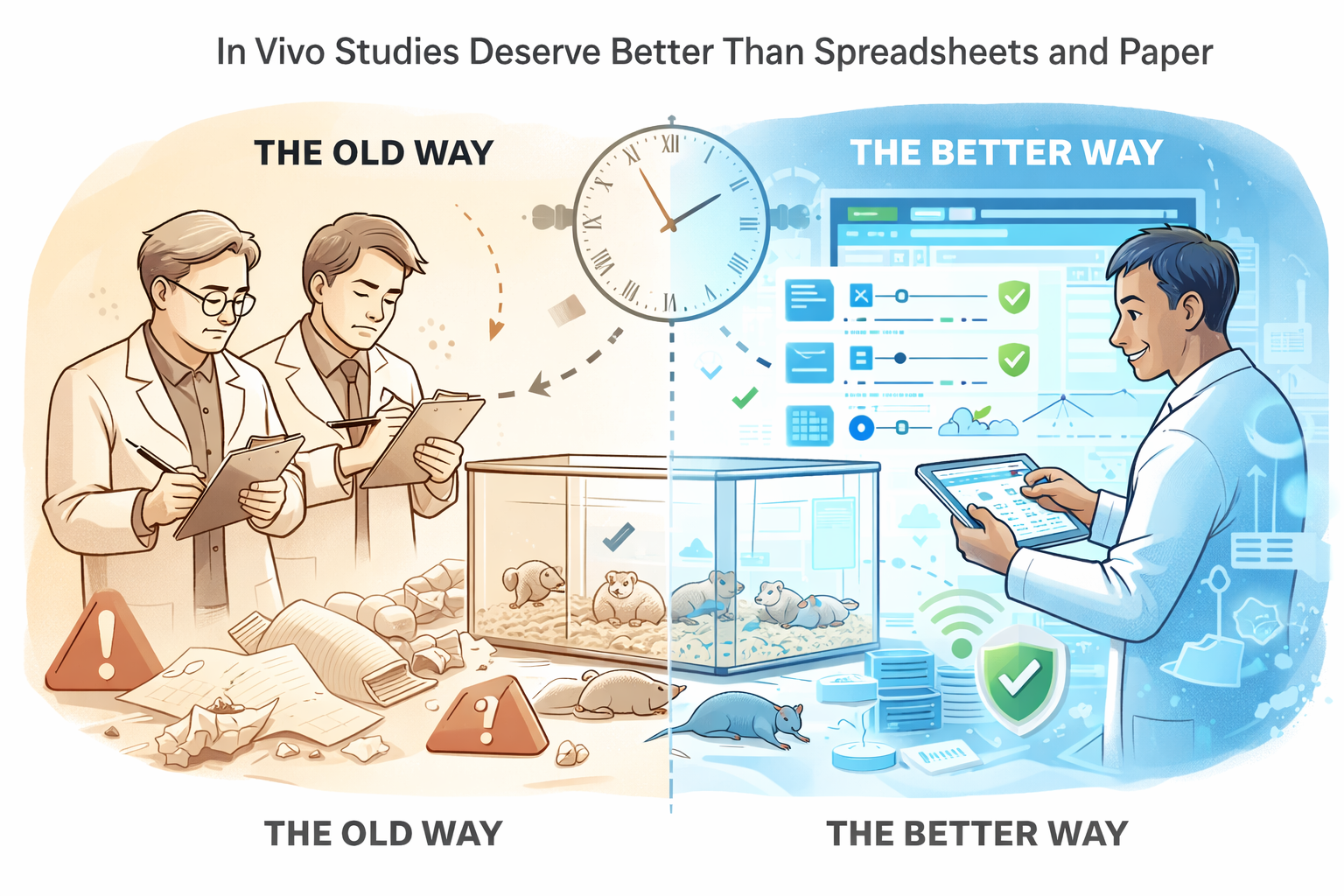
In vivo pharmacology studies directly influence go/no-go decisions, candidate prioritization, and millions of dollars in downstream investment. Yet in many organizations, these studies are still planned in Excel, executed on paper, and reconstructed after the fact. There is a growing mismatch between the importance of in vivo data and the tools used to generate it.
“In vivo studies are too important for paper workflows.”
A Critical Workflow Stuck in the Past
Throughout my career in pharmaceutical research, I have observed that most pharmacology labs and scientists conduct in vivo studies using the same traditional methods. Many still relay on elaborate Excel spreadsheets to configure experiments, which are then printed and taken into the vivarium where measurements and clinical observations are recorded by hand on paper.
In vivo studies are among the most complex and consequential experiments in drug discovery and development. Despite their value, many organizations continue to use rudimentary tools to define, execute, and capture this critical data.
Why In vivo Has Resisted Digitization
The persistence of these workflows is not due to resistance to change, but to the reality of in vivo science. First, in vivo studies are inherently complex and highly variable. They do not fit neatly into rigid, form-based electronic systems, many of which have been tried and quietly abandoned. Second, the vivarium is a fast-moving, and often chaotic environment, particularly during large studies. Pharmacologists must manage numerous (i.e., dozens or hundreds) animals on tightly constrained schedules and have little tolerance for friction or delays. Effective solutions must be flexible enough to accommodate complex study definitions while remaining practical enough to function within the reality of the vivarium.
Software That Misses the Scientist
Over time, many software systems have attempted to address this problem, and new vendors enter the space regularly. However, most of these tools carry the limitations of their origins. Some systems grew out of animal husbandry, focusing on breeding, surgical interventions, pharmacological treatments, and welfare monitoring. While these platforms ensure animals are tracked and treated humanely and consistently the pharmacology study workflow is often added as an afterthought. Other tools originated from analytical instrumentation, such as LC-MS data systems that were extended to handle downstream analysis. In both cases, the actual experience of the scientist working in the vivarium is rarely the primary design driver.
“Compliance alone isn’t enough – scientist experience matters.”
An End-to-End Problem Still Waiting for a Solution
Pharmaceutical and biotech companies are increasingly motivated to integrate in vivo results into their broader data and project infrastructure. To date, most efforts have been limited in scope, either focusing on the researcher’s experience during study execution or attempting to parse Excel files into corporate data lakes. The end-to-end integration of in vivo study planning and execution into the overall drug discovery data and project management fabric remains largely unsolved.
“End-to-end integration shouldn’t start with parsing Excel.”
Building Progress with Scientists, Not Around Them
Real progress in modernizing in vivo research will not come from forcing labs into rigid systems or layering technology on top of broken workflows. It comes from working alongside scientists to understand where friction truly lives, addressing practical pain points first, and building trust through tools that make daily work easier rather than more complicated. When solutions are shaped by the realities of the vivarium and guided by the people doing the science, digital transformation stops being an abstract IT initiative and becomes a meaningful improvement to how critical decisions are made. In vivo studies are too important to be constrained by outdated processes and the path forward starts with collaboration, not just software. This was exactly the approach we took with Vivo Facile. Built on our SciDataHub platform, it was specifically developed to address the challenges associated with running in vivo pharmacology studies.
These Capabilities Matter Just as Much to IT & Informatics Leaders than Scientists & Pharmacologists
| Element | Why It Matters to IT & Informatics Leaders | Why It Matters to Scientists & Pharmacologists |
|---|---|---|
| Flexible study design (no rigid forms) | o Reduces customization and support burden over time. o Prevents brittle systems that fail when protocols | o Supports real-world studies that change as data emerges. o Avoids workarounds and duplicate documentation. |
| Digital data capture in the vivarium | o Eliminates paper-based processes that introduce risk, transcription errors, and audit gaps. | o Removes the need to write observations on paper and re-enter data later. o Keeps focus on animals and science. |
| Works at vivarium pace | o Increases adoption and system longevity by avoiding tools that are bypassed in practice. | o Doesn’t slow down dosing, observations, or time-sensitive procedures during busy study days. |
| Designed around pharmacology workflows | o Reduces the need to integrate multiple niche tools or force-fit systems not meant for in vivo execution. | o Reflects how studies are actually run, not how software designers imagine them. |
| Structured, enterprise-ready data | o Enables clean integration into data lakes, analytics platforms, and project systems without post hoc cleanup. | o Ensures results are usable immediately without extra formatting, manual fixes, or Excel wrangling. |
| End-to-end study lifecycle coverage | o Provides traceability from study design through execution and results for compliance and governance. | o Keeps all study information in one place, reducing confusion and context switching. |
